
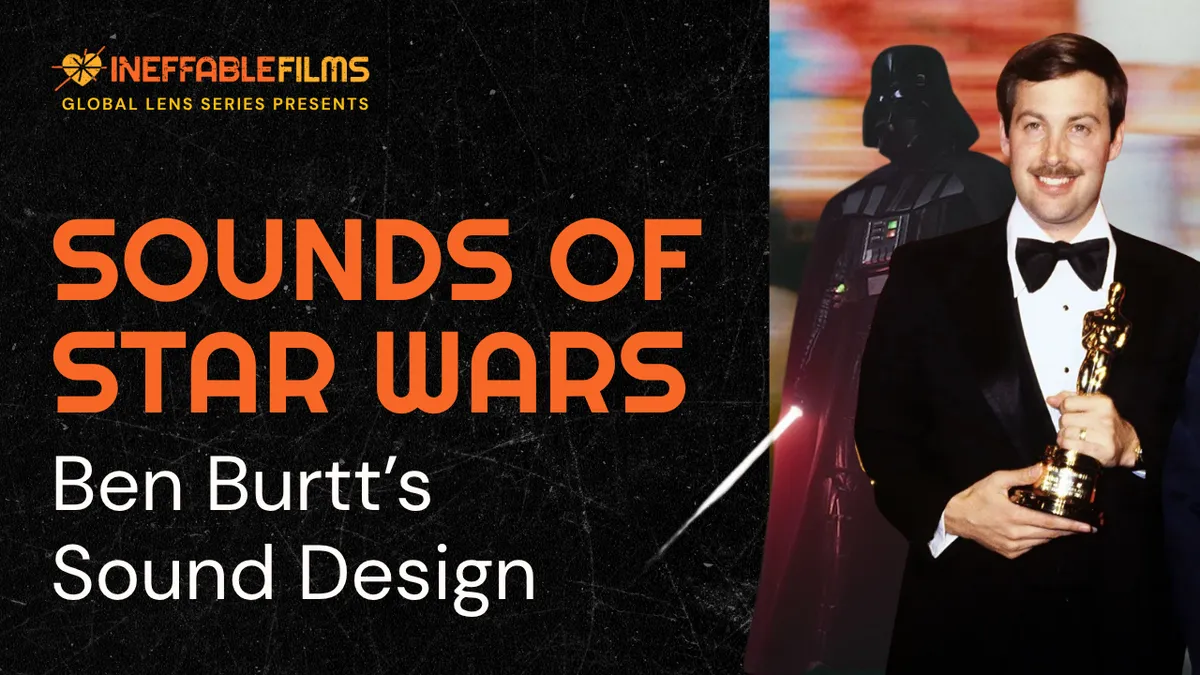
The Sounds of Star Wars: How Ben Burtt Invented Alien Languages (Global Lens Ep. 2)
Watch the episode: [ADD YOUTUBE URL]
Ben Burtt made the sounds you would recognize in a dark room with your eyes shut. The lightsaber. Vader’s breathing. R2-D2. What is easy to miss is that his hardest problem was never the machines. It was mouths.
A year of listening for one voice
George Lucas gave Burtt a starting point that was barely a direction: something like a bear. Burtt spent roughly a year gathering animal recordings. Bears, yes, but also walruses, lions, badgers, and a long list of others.
Then came the real work, which was not recording. It was sorting. He went back through everything looking for individual sounds that could carry one specific feeling. Not a bear sound. A bear sound that reads as worry. One that reads as affection. One that reads as a warning. Chewbacca’s voice is those fragments mixed and matched into a vocabulary.
He also built it around the limits of the costume. The performer’s mask could not do much more than open and close, so every sound had to be believable coming out of a mouth with almost no range. Anything shaped by lips or a tongue would
have broken the illusion on the spot. Burtt designed to the mask, and that restriction is part of why Chewbacca reads as a living animal instead of a man in a suit.
Where the languages actually came from
For the characters who needed to speak rather than growl, Burtt went looking for real human languages, and he looked a long way outside English.
Jabba the Hutt speaks Huttese, improvised from Quechua, an Indigenous language spoken across the Peruvian Andes by millions of people today. The Ewoks speak a version of Kalmyk, a Mongolic language from southern Russia, recorded from an elderly woman telling folk stories in her own tongue, with Tibetan and Nepali woven through it.
Sit with that for a second. The galaxy far, far away was assembled out of languages from the Andes, the Russian steppe and the Himalayas, spoken by people the credits never name. When Star Wars sounds ancient and unplaceable, it is because it is borrowing from tongues that really are old, and that Hollywood almost never bothers to record.
That is worth saying plainly instead of filing it under trivia. Sound design is often the place where a film quietly admits how much of itself came from somewhere else.
Try this on your next project
Build your library before you need it. Record the sounds and the voices around you now: your street, your kitchen, your family’s language. Burtt’s advantage was a year of raw material to choose from, and the choosing is where the character actually got made. You cannot sort through a collection you never gathered.
Who made this
Host: Brianna Andersen
Writer: [TK]
Editor: [TK]
Animation: [TK]
Music: [TK]
Keep going: The MacGuffin · Step Printing
About Global Lens
Global Lens is a film education series from Ineffable Films, a 501©(3) nonprofit working out of San Diego, New York, Los Angeles and Boston. Each episode traces a single technique or cultural contribution that shaped cinema, with an eye on the filmmakers and traditions that standard film history tends to skip. The series sits inside our wider work empowering emerging and underserved filmmakers through mentorship, festival access, education and community screenings.
Watch the full series
Join Open Hours, our free filmmaker community


